



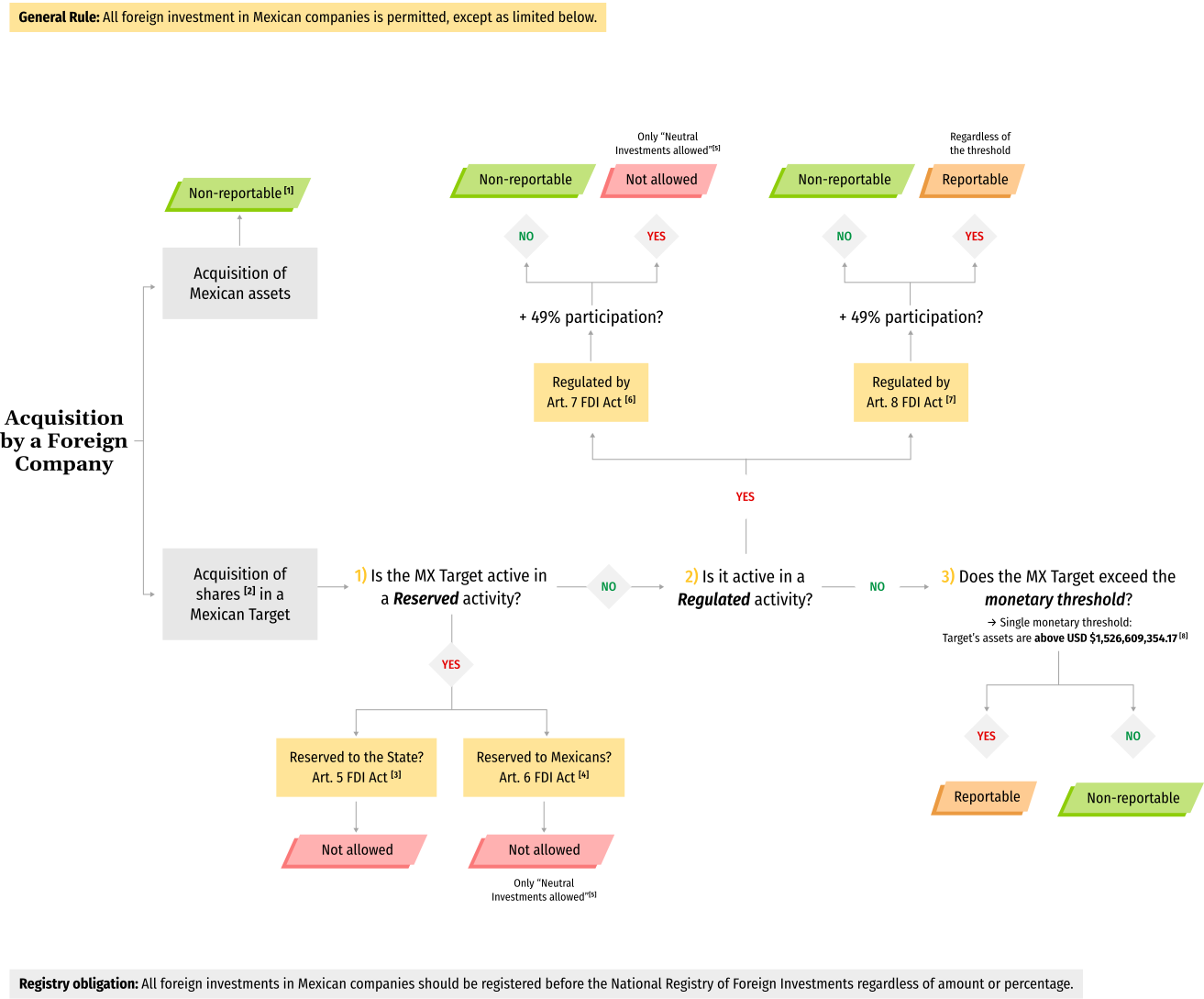
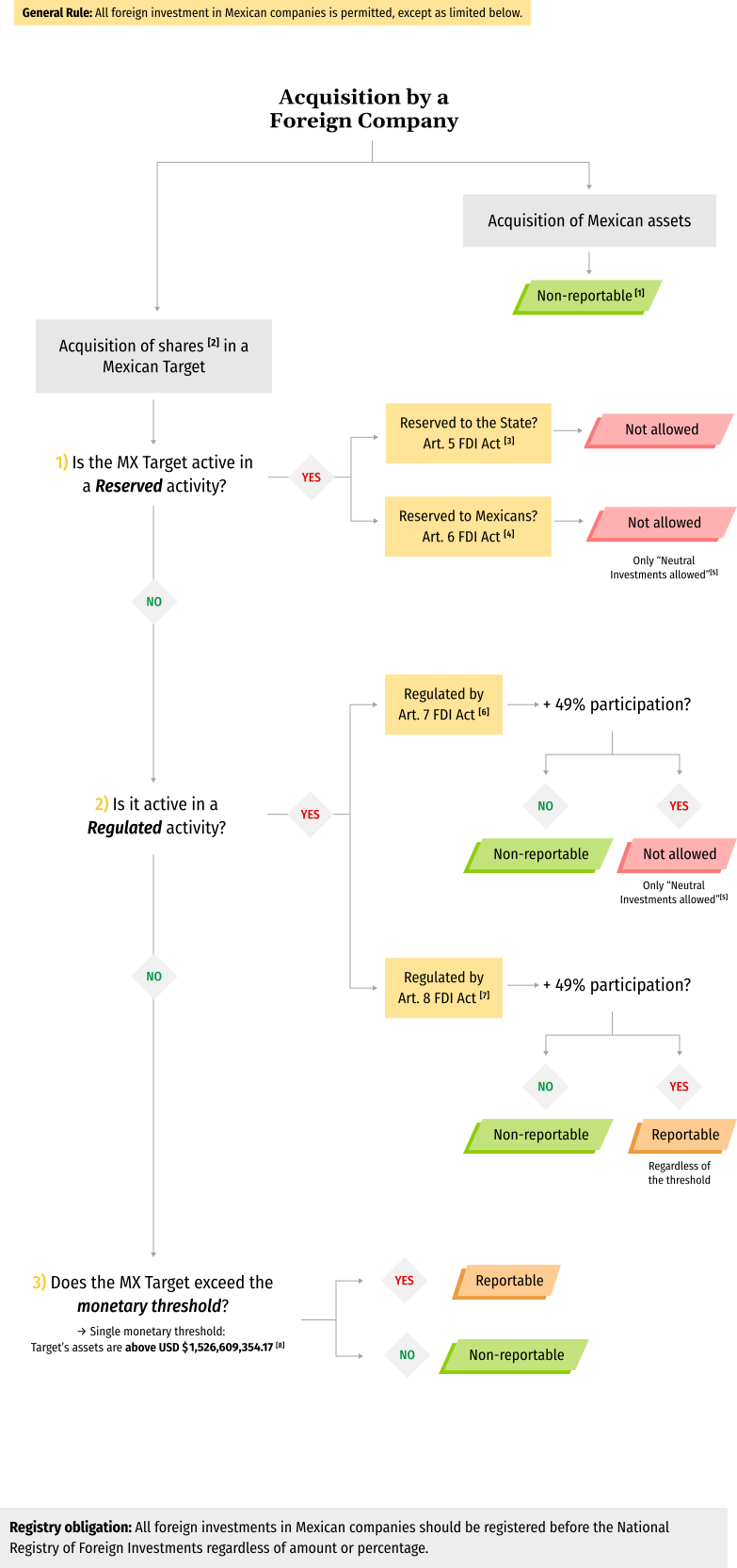
Reportability pursuant to the Foreign Investment Act (“FDI Act”, or Ley de Inversión Extranjera).
 NOTES
NOTES[1] When referring to assets, this is generally the case; however, it is necessary to conduct a review to ensure that this does not contradict any provisions related to restricted or prohibited activities, depending on the relevant transaction. For instance, foreign investors are constitutionally restricted from directly acquiring real estate located within 100 km from the borders or 50 km from the coastline. However, such acquisitions are allowed through Mexican bank trusts (fideicomisos) authorized by the Ministry of Foreign Affairs (SRE), commonly used for residential or tourism-related purposes.
[2] Includes transfers of shares, equity interests, or companies.
[3] As per Article 5 of the FDI Act, includes: (i) Oil and hydrocarbon exploration and extraction; (ii) National electricity system control; (iii) Nuclear energy generation; (iv) Radioactive minerals; (v) Telegraph services; (vi) Radiotelegraphy; (vii) Postal services; (viii) Banknote issuance; (ix) Coin minting; (x) Port, airport, and heliport oversight; and (xi) Other legally designated activities.
[4] As per Article 6 of the FDI Act, includes: (i) National land transport (passengers and cargo); (ii) Development banking institutions; and (iii) Legally designated professional or technical services.
[5] The Ministry may authorize fiduciary neutral investment instruments granting their holders only pecuniary rights and limited corporate rights, without voting rights (Art. 19 FDI Act). Neutral investments always require authorization.
[6] As per Article 7 of the FDI Act, includes: (i) Explosives and firearms manufacturing; (ii) Newspaper printing (for exclusively national circulation); (iii) Series “T” land-owning shares; (iv) Inland, coastal, and exclusive zone fishing; (v) Comprehensive port administration; (vi) Port pilotage services; (vii) Commercial inland shipping operations; (viii) Fuel for ships and trains; (ix) Broadcasting (with reciprocity rule); and (x) National and international air transport services. In the case of cooperative production societies, the threshold is 10 percent.
[7] As per Article 8 of the FDI Act, includes: (i) Port services such as towing, mooring, and launching; (ii) Shipping companies in deep sea traffic; (iii) Public use airport concessionaires; (iv) Private education services (all levels); (v) Legal services; and (vi) Railway construction and public operation.
[8] In Mexico, there is only one threshold determined annually (around midyear) by the National Commission of Foreign Investments (CNIE) based on the asset value of the Target in Mexico.
Currently, MXN $28,623,925,390.72 according to the General Resolution of the CNIE published
on the Official Gazzette on August 5, 2025 at:
https://www.dof.gob.mx/nota_detalle.php?codigo=5764663&fecha=05/08/2025#gsc.tab=0
Exchange rate for conversion to USD = 1 USD = 18.75 MXN
Precedents suggest a new CNIE authorization should not be required for a foreign investor acquiring an interest in a Mexican company for which majority foreign investment has already been authorized. The key distinction is that the CNIE typically authorizes both the foreign investor to acquire a specific stake and, more broadly, the foreign investment itself to exceed the 49% threshold. Once the majority foreign investment is authorized, subsequent transters to other foreign investors should not require a new authorization, since the regulatory trigger is tied to the foreign capital participation level, not the investor's identity. Moreover, the criteria the CNIE applies under Articles 29 and 30 of the Foreign Investment Act -such as impact on employment, technology transter, environmental compliance, competitiveness, and national security- are "impersonal" and can be met either by the foreign investor or the Mexican company receiving the investment. Thi sreinforces the idea that once these criteria have been satisfied and the majority foreign investment is approved, the authorization remains valid regardless of future changes in the foreign investor. While this approach is supported by precedents like ASUR and GAP, where the CNIE granted majority foreign investment authorization, and the companies publicly disclosed that the restriction no longer applied to future foreign shareholders, there is no certainty that the CNIE will apply it in any given scenario.
On December 7, 2023, the U.S. and Mexico signed a Memorandum of Intent to create a joint working group on foreign investment screening (source). This move points to tighter FDI enforcement ahead, especially in sectors tied to national security. With Washington’s tough stance on China, it’s likely the U.S. will push Mexico to step up oversight of investments from certain countries. We’re keeping a close watch and will keep you updated on anything that could affect cross-border deals.
“In 2025, COFECE has already logged 35 merger control cases. At this pace and despite the uncertainty surrounding antitrust enforcement and the economy generally, this could be a record year in merger control”.
Merger control in Mexico has become increasingly complex as agencies ever more resort to tools such as extensive information requests and market testing. This, coupled with more sophistication of staff in certain industries, has resulted in longer proceedings in recent years (see Figure 1). Antitrust enforcement in the telecommunications and broadcast industries will come back to the new agency, and Congress currently analyzes proposals to lower filing thresholds4 and to incorporate a new category of reportable transactions5. This, together with potential further staff cuts in the name of government efficiency can create an even greater workload for the Merger Control Division, which will likely result in longer review periods, unless the new agency is able to revitalize the obsolete fast-track procedure. The latter may be true even for non-issue acquisitions by private equity funds or for real estate transactions, where the average timing estimate has increased from 1.5-2 months to 2.5-3 months. 6

Data for 2024 is not available yet, but growth trend is likely to continue due to unlimited extensions in RFIs and increasing market tests and review of internal documents and e-mails/messages.

Mexico's antitrust landscape is changing rapidly. In response to domestic political pressure as well as global trends of bringing competition law closer to consumers, Mexico will have a new antitrust law and a new antitrust authority. Antitrust in Mexico is not disappearing though. Rather, it is evolving into a "whole-of-government" approach that will likely reflect the priorities of the administration, and intensively use enforcement tools in industries that are more sensitive to the working class and low-income communities while trying to ensure compliance with the USMCA1. These changes are taking place against the backdrop of a profound overhaul of the judicial system, which is expected to be more favorable to the agenda of the current government.
What can we expect to see in Mexico in the short term? A combination of legacy and innovation. Key officials from the Mexican antitrust authority, COFECE, are expected to remain in place. This will provide continuity to current trends in merger control and investigations. Notwithstanding, the legislature has already expressed the need for faster proceedings (including investigations), higher fines and a wealth-redistribution approach, this last one under the guise of excessive pricing sanctioning and enforcement. Also, while the law may include references to market neutrality2 it is no secret that the Mexican government's industrial policy includes a big push for state-owned companies, particularly in the energy sector (and perhaps also in the telecommunications sector -given the recent acquisition of Altán3 ). This will naturally create an interesting mix in the already politicized antitrust arena.
Against this background, companies and dealmakers need less speculation and more fact-based insights. This document presents what we believe are key trends and potential changes to keep an eye on when assessing the regulatory implications of transactions and investigations with a Mexican component.
Soon, Mexico will have a new antitrust law and a new antitrust authority. A new bill to reform the current Competition Law has been published by the Mexican Congress on April 24, 2025 (the "Executive's Branch Bill" or the "Bill"). The Bill was proposed directly by President Sheinbaum and will be discussed in the upcoming days. It could be approved before the closing of the Ordinary Session of the Congress, although President Sheinbaum has also hinted that the approval can wait until September
The antitrust reform will significantly impact Mexico's antirust landscape. While this antitrust reform initially responds to domestic political pressure, it also aligns with the global trend of competition authorities prioritizing the elected government's agenda and issues most relevant to average consumers. The Bill reflects the recent industrial policy approach in our Constitution by stipulating that state owned companies, such as PEMEX and CFE, cannot be considered monopolies. With the inclusion of the new National Antitrust Commission (Comisión Nacional Antimonopolios, CNA) into the Ministry of Economy, Mexico's antitrust landscape is evolving into a "whole-of-government" approach likely to reflect the administration's priorities and intensively utilize enforcement tools in industries particularly sensitive to the working class and low-income communities, all while trying to ensure compliance with the USMCA.
Although the essentials of existing law are maintained, this bill brings important changes to the Mexican antitrust ecosystem. Changes include significantly higher fines, considerably shorter procedures in investigations and merger control (subject to budget constraints), lower merger thresholds, and more procedural sanctions. The legislation also takes decisive steps toward the adoption of compliance programs and damages litigation and includes a harsher approach on legal privilege. As opposed to previous bills, it does not include the concept of exploitative prices, but it adopts a stricter approach to abuse of dominance beyond foreclosure. Finally, the bill aims to formalize procedural criteria and internal organization decisions adopted by our antitrust authority in recent years.
What can we expect to see in Mexico in the short term? A combination of legacy and change. The formalistic idiosyncrasy of our judicial system is likely to keep shaping our antitrust enforcement and merger control proceedings. In addition, current key COFECE officials are expected to remain in place, and which will provide continuity in merger control and investigations. Differences will be more on the industries that will likely be targeted by the Government. It is no secret that the Mexican government's industrial policy includes a big push for state-owned companies, particularly in the energy sector (and perhaps also in the telecommunications sector, given the recent acquisition of Altán1 ). Industries that are closer to the everyday person are likely to be prioritized but we also expect the CNA to keep looking into digital markets, in coordination with the Digital and Telecommunications Agency. Good news is that returning antitrust jurisdiction over telecoms and broadcasting markets to the new agency will remove the extensive and procedurally difficult discussions between COFECE and IFT that pushed merger control timelines for months or resulted in costly, dual filings.
In sum, Mexico is likely to experience more vigorous antitrust enforcement aligned more closely with the Executive branch's priorities, similar to trend in other jurisdictions.
Below is a table summarizing of the key changes that global practitioners and companies with operations in Mexico should watch closely for their transactions and operations in Mexico:
The Current Law monetary thresholds are based on (i) size of the transaction, (ii) size of the target (assuming an acquisition of 35% or more), and (iii) size of the parties.1
Establishes a one-year statute of limitation for below-the-radar transactions.2
Reduction of the monetary thresholds by approximately 11%-17%.3 Reduction of the acquisition threshold from 35% to 30% of the shares or assets of the target.
Expands the statute of limitations for below-the-radar transactions to three years4.
Reduction of the monetary thresholds by approximately 17%-40%.4 Includes a new threshold for JVs and collaboration agreements based on the size of the parties.
Expands the statute of limitations for below-the-radar transactions to three years.
COFECE can extend its maximum period of 120 business days for cartel, abuse of dominance and unlawful mergers investigations up to 4 times5.
For merger control, the Current Law mandates that a decision should be issued in 60 business days (plus an additional extension of 40 business days).
The 120 business days investigation period can only be extended 3 times. Term to issue a final decision in investigations was also reduced from 40 days in the Current Law to 30 days6 . The Board of Commissioners period for ruling on merger-control filings is reduced from 60 to 30 days, from filing admission7. On barriers to competition and essential input investigations8, periods for (i) issuing a statement of objections, and (ii) for the Board of Commissioners to issue a ruling, are reduced from 60 to 40 days. Nonetheless, timelines will heavily depend on budget constraint and staff resources of the new commission.
Among others, Current Law establishes an exception to report (i) foreign transactions of companies acquiring targets with no assets or subsidiaries in Mexico,1 and (ii) acquisitions by investment funds merely for speculation purposes.
It removes both exceptions. Local Nexus with Mexico can now apply to transactions with targets that have sales to Mexican consumers even if having no assets or subsidiaries in Mexico. In addition, transactions by any type of investment vehicle can be captured regardless of its purpose.
Same as Current Law.
The concept of limiting the capacity to compete is not provided for in the Current Law as abuse of dominance conducts2. Current law focuses on foreclosure when addressing abuse of dominance
In addition to foreclosure, it considers that wrongfully “limiting the capacity to compete” of other agents in the market is within the scope of abuse of dominance.
Current Law establishes fines 3 for both substantive and procedural infringements, e.g., (i) submit false information, (ii) cartels (up to 10% of the company’s income), (iii) abuse of dominance (up to 8% of the company’s income), (iv) unlawful mergers (up to 8% of the company’s income), (v) unreported mergers (up to 5% of the company’s income), among others.
Provides for fines up to twice as high for substantive infringements (e.g., cartels, abuse of dominance, and unlawful mergers)4 and higher fines for procedural infringements such as providing false information.5 In addition, it includes coercive measures for obstructing dawn raids6 or failing to appear at a deposition7. Contemplates limitations to contracts with government entities if sanctioned for bid rigging8. Maximum fines for foreign entities would also be significantly higher9.
Legal privilege has virtually no regulation in Mexico. COFECE issued some Regulatory Provisions11, establishing a qualification procedure, at the request of agents. A qualifying committee within COFECE reviews the requests and determines eligibility. If applicable, excludes or returns the information, restricting access to non-authorized officials to ensure protection.
Establishes a “first look, then-decide” procedure similar to COFECE’s current provisions. Suspensive and applicable to all procedures. In-house lawyers and economists will not be considered to have privilege.12
The Current Law does not provide any benefits or regulations regarding the implementation of antitrust compliance programs.
Compliance programs that are certified by the new Antitrust National Commission (CNA) can reduce fines. The CNA will certify compliance programs (subject to an application fee), and such certification will be valid for three years.13
Same as Current Law.
Comisión Federal de Competencia Económica (COFECE, Federal Economic Competition Commission)
Independent constitutional body, autonomous from the executive branch. Seven commissioners, including a Chairperson, picked by the President from a pre-selected shortlist of those passing applicable technical exams and ratified by the Senate. They serve staggered terms of nine years.
Comisión Nacional Antimonopolio (Antitrust National Commission)
Independent agency attached to the Ministry of Economy. 14 Five commissioners designated by the executive branch and ratified by the Senate.15 Seven-year staggered terms. President will directly appoint the Chairperson for a three-year term, with the possibility of one reelection. Executive branch can remove Commissioners due to serious cause.
Instituto Federal de Telecomunicaciones (IFT) has jurisdiction over antitrust matters in telecoms and broadcasting sectors. COFECE has challenged IFT for jurisdiction over certain sectors (e.g. digital markets), which has resulted in delays in merger control cases, for instance.
CNA has jurisdiction over antitrust matters including telecoms and broadcasting. No more merger control jurisdictions or investigations disputes with the Telecommunications agency. The Proposal establishes procedures to review cross-ownership, concessions, determination of Predominant Economic Agents and asymmetric regulation for those dominant players. Strict coordination with the new Digital and Telecommunications Agency.16
The Current Law provides for the possibility to carry out dawn raids and depositions to investigate potential violations to the law.17 It includes the obligation to “facilitate access” during a dawn raid and fines for not showing to a deposition.
Establishes higher fines for not showing to a deposition or not cooperating during interrogation 18. The lack of cooperation during dawn raids, depositions and other proceedings is not explicitly mentioned as an aggravating factor when calculating fines.
The Current Law provides for the possibility to apply for a Leniency program in cartel cases.19 The first applicant is entitled to a full fine waiver and avoid criminal prosecution regardless of whether the investigation has already begun or not.20
It also includes fine waivers or reductions for abuse of dominance and unlawful mergers, provided that the parties cease the conduct and offer remedies at any stage of the investigation phase.21
The leniency program is more restricted. The full waiver benefit is available to the first applicant only if investigation has not started yet. If it has already begun, the benefit could be of up to 50.22
Limits the fine waiver benefit to the ones requesting it before the second extension of the investigation procedure in abuse of dominance and unlawful mergers.23 If requested later, only a 50% maximum fine reduction is available.
Proposes that the Agency will have new faculties to issue specific regulations on fine reduction and leniency programs.40
The Current Law contemplates the possibility of claiming damages until the resolution of the Commission has become “final”. This could be interpreted as having to wait until the court decision in an amparo proceeding.
Clarifies that individual claims or class actions can be initiated as soon as the CNA issues a decision and that the statute of limitations will start with such decision.
Considers the possibility of posting guarantees in response to the imposition of interim measures. Limits to the imposition of interim measures are contained in regulatory provisions issued by the Commission
Does not include the possibility of posting guarantees. Limits to the imposition of interim measures will fall on regulations to be issued by the executive, for which judicial review will remain available. Eliminates pervious proposals in which market inquiry proceedings (art. 94) were explicitly mentioned as subject of interim measures.
No longer includes the possibility for asset divestiture in telecoms markets to guarantee compliance with imposed measures as in previous proposals32.
The Current Law does not include special provisions for claims coming from governmental authorities.
Includes the possibility for the Ministry of Economy to claim law violations. The Commission must review these complaints with “available information” within 30 days to determine if an investigation is warranted. If not, it must notify the Ministry of the reasons for not starting an investigation24.